 Yard Material Lab
Compare material quantities
Mulch at 2 Inches vs. 3 Inches: How Much Does the Quantity Change?
Follow two worked examples, compare cubic feet and yards, and calculate whole bags from the label.
Open the mulch calculatorFor the same bed, moving from 2 inches of mulch to 3 inches increases the calculated volume by 50%. That relationship is pure arithmetic: 3 ÷ 2 = 1.5. It does not mean that every project should use either depth.
Choose depth from the requirements for your specific project, existing layer, plants, product, and site conditions. The comparison below answers one narrow planning question: if the area and every other input stay the same, how does the required volume change?
The formula
For a rectangular bed measured in feet:
area in square feet = length × width
volume in cubic feet = area × (depth in inches ÷ 12) × (1 + allowance ÷ 100)
volume in cubic yards = cubic feet ÷ 27
The extra allowance is optional and deliberate. It is not an automatic prediction of compaction, settling, spillage, or supplier rounding.
Worked comparison: a 15 ft by 6 ft bed
The bed area is:
15 × 6 = 90 square feet
To compare only depth, keep the area and a hypothetical 10% allowance unchanged.
At 2 inches
First calculate the base volume:
90 × (2 ÷ 12) = 15 cubic feet
Then add the chosen 10% allowance:
15 × 1.10 = 16.5 cubic feet
Convert to cubic yards:
16.5 ÷ 27 = 0.6111… cubic yards, which rounds to 0.61 cubic yards.
At 3 inches
The same bed at the second example depth gives:
90 × (3 ÷ 12) = 22.5 cubic feet
22.5 × 1.10 = 24.75 cubic feet
24.75 ÷ 27 = 0.9166… cubic yards, which rounds to 0.92 cubic yards.
The difference is 24.75 − 16.5 = 8.25 cubic feet, or about 0.31 cubic yards. Because area and allowance did not change, the 3-inch result remains exactly 1.5 times the 2-inch result.
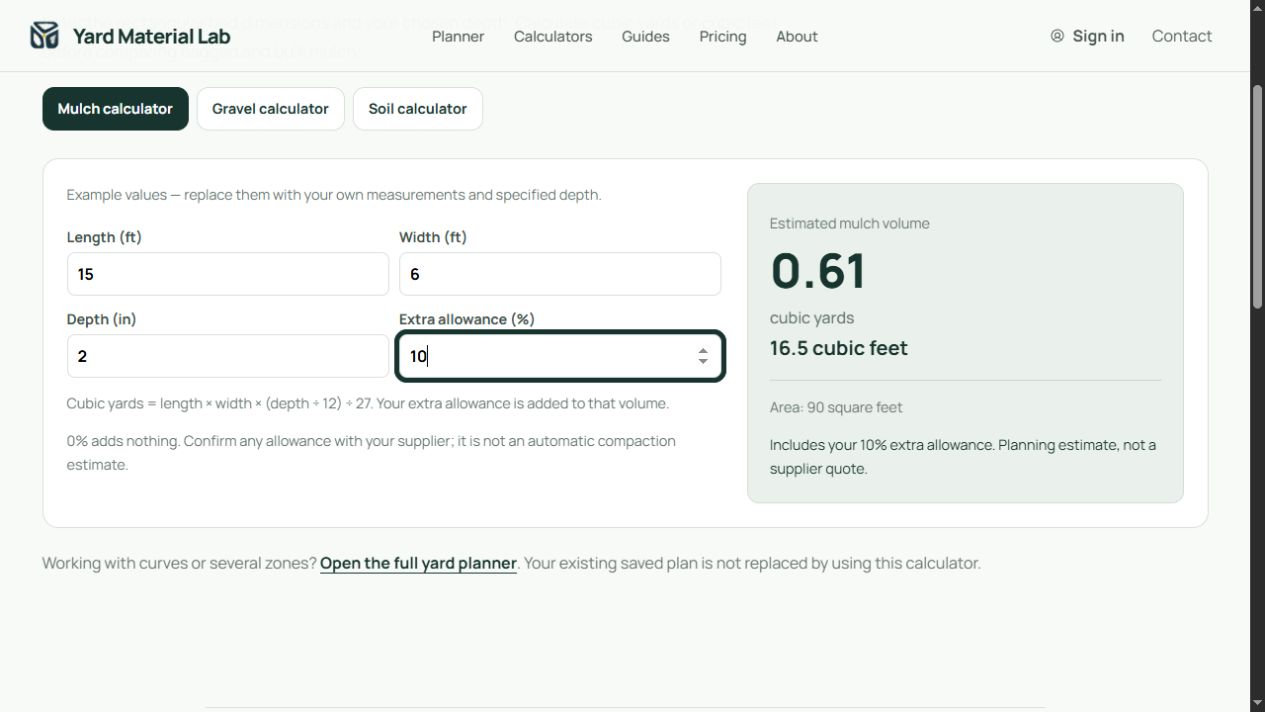
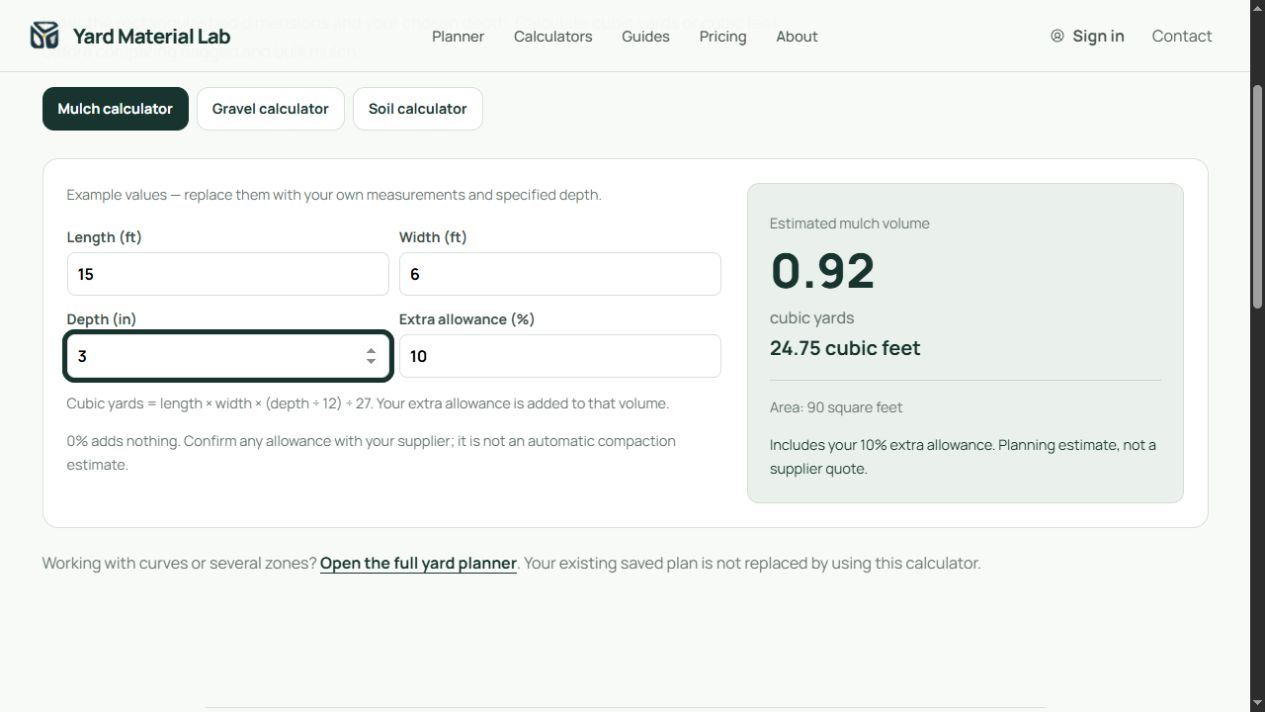
These screenshots show calculator inputs and volume results. Bag counts below are calculated separately from an assumed bag capacity.
Convert either result to whole bags
The dedicated Yard Material Lab mulch calculator reports area, cubic feet, and cubic yards. It does not ask for a bag capacity or display a bag count. To estimate whole bags, read the volume printed on the exact product bag, divide the calculated cubic feet by that capacity, and round up when ordering only whole bags.
Using an explicitly hypothetical 2-cubic-foot bag:
16.5 ÷ 2 = 8.25, so the 2-inch example rounds up to 9 bags.
24.75 ÷ 2 = 12.375, so the 3-inch example rounds up to 13 bags.
The rounded bag count rises by four, although the underlying volume rises by 50%. Whole-unit rounding is why bag counts do not always preserve the exact percentage relationship.
Bag capacity matters. For the 24.75-cubic-foot result, hypothetical 1.5-cubic-foot bags give 24.75 ÷ 1.5 = 16.5, rounded up to 17 bags. Hypothetical 3-cubic-foot bags give 24.75 ÷ 3 = 8.25, rounded up to 9 bags. Check the label rather than reusing a capacity from another product.
A second size check without an allowance
For a 20 ft by 12 ft bed, the area is 20 × 12 = 240 square feet. With no extra allowance:
- At 2 inches:
240 × (2 ÷ 12) = 40 cubic feet, and40 ÷ 27 = 1.4814… cubic yards, or about1.48 cubic yards. - At 3 inches:
240 × (3 ÷ 12) = 60 cubic feet, and60 ÷ 27 = 2.2222… cubic yards, or about2.22 cubic yards.
The additional inch adds 20 cubic feet, and the 3-inch volume is again 50% higher. Changing the bed size changes the totals, but not the 3-to-2 depth ratio.
Account for an existing mulch layer
Do not automatically calculate the full visible depth as new material. If usable mulch is already present, determine the additional layer you actually intend to place and use that added depth as the calculator input. Conditions can vary within one bed, so separate measurements may be clearer than applying one depth everywhere.
This article does not decide whether existing material should remain, be removed, or be replaced. It also does not prescribe plant care, drainage, pest management, or a standard installation depth. Resolve those questions from appropriate project or product guidance before estimating quantity. The result is a planning estimate, not a supplier quote.
Frequently asked questions
Is 3 inches always better than 2 inches?
No. This is a quantity comparison, not a recommendation. Use the depth specified for your project and material.
Why does one extra inch add 50%?
The starting depth is 2 inches. One inch is half of 2, so increasing the depth to 3 inches multiplies volume by 3 ÷ 2 = 1.5 when area and allowance stay constant.
Should I always add 10%?
No. Ten percent is an example input here. Choose any allowance deliberately and confirm how the exact product and supplier handle ordering, minimums, rounding, settling, and compaction.
Use the free mulch calculator to replace the examples with your own length, width, project depth, and chosen allowance, then convert the displayed cubic feet to bags only after checking the product label.